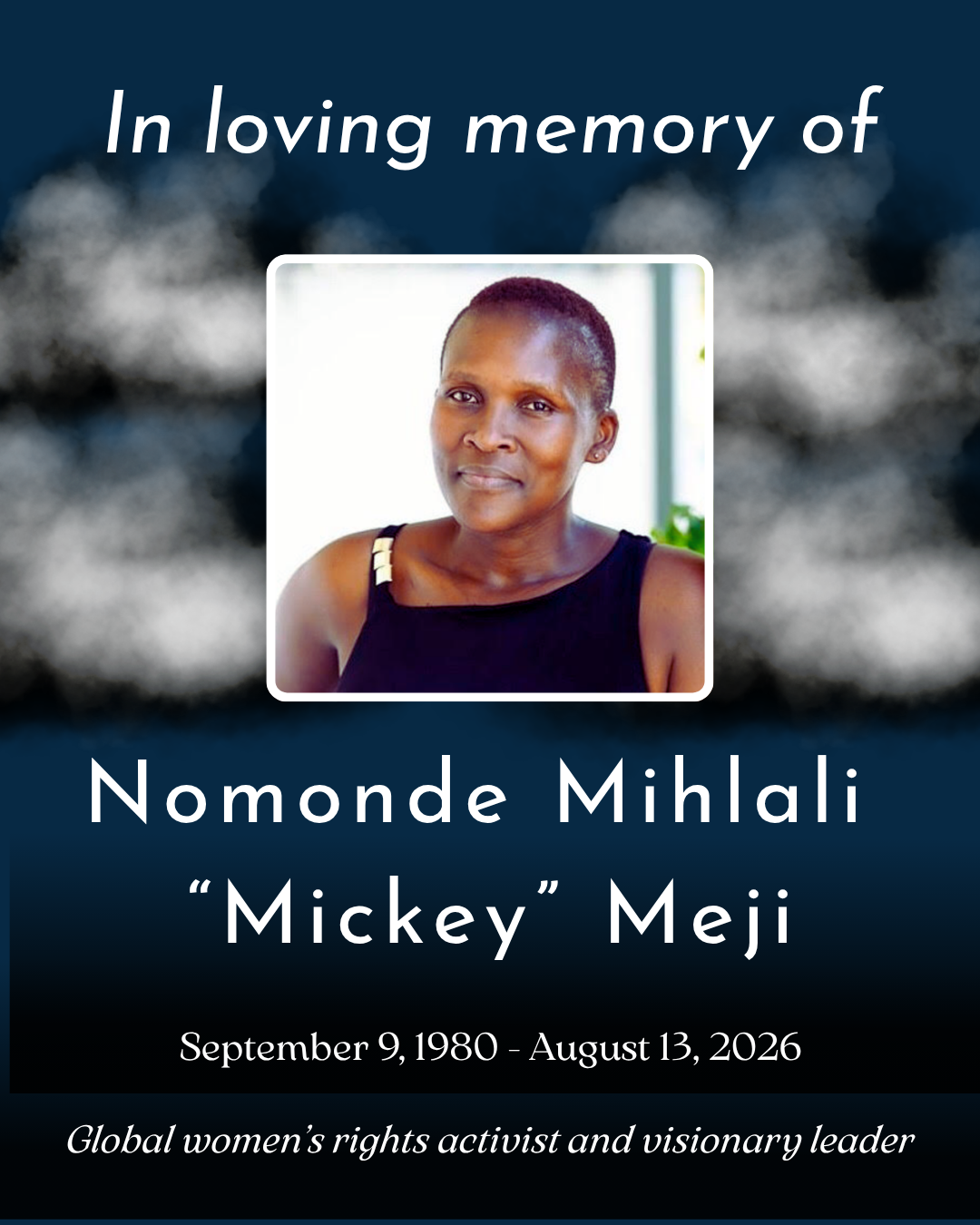
Written by Nozizwe Madlala-Routledge and Jeremy Routledge on behalf of Embrace Dignity
Mickey Meji died on 13 August 2026, a few weeks before turning 46 years of age. Representing Embrace Dignity, we accompanied her three children to Khayelitsha Hospital, where she had been hospitalised. The doctor sat us down and gently informed us that Mickey had drawn her last breath at about noon that day. We asked if we could see her. She looked peaceful, as if she was simply sleeping, as if she would wake and smile. We all shed tears — tears of sadness, and tears of gratitude for her life.
It is hard to believe that she is gone. But it is easy, even now, to remember exactly who she was: a gallant fighter for the rights of women and girls caught in the system of prostitution, and one of the most courageous voices this country has produced in the struggle against sexual exploitation.
Meji joined Embrace Dignity as a Programme Associate for Survivor Initiatives in 2016, but her commitment to the cause ran far deeper than any job title could capture. Embrace Dignity has, since its formation in 2010, campaigned for an end to all forms of sexual abuse of women and girls through legal advocacy, public education and exit services for trafficked and prostituted women — and Mickey became one of the campaign’s fiercest and most eloquent champions. She had survived the system herself, and she turned that survival into a lifelong fight so that other women would not have to endure what she had endured.
Her words ring in my head.
In March 2018 she led a delegation of survivors to a hearing organised by the Parliamentary Women’s Caucus on the South African Law Reform Commission’s report on Project 107 – Adult Prostitution. On that day, Mickey told Parliament:
“Women in prostitution do not wake up one day and decide to be prostituted, but prostitution is chosen for us by our colonial past and apartheid — which limited our access to and protection of basic human rights like education, dignity and security of the person as enshrined in the Constitution — persistent inequalities, poverty and patriarchy.”
At the heart of Mickey’s advocacy was her unwavering call for the enactment of the Sankara Equality Law — a rational, humane legal framework that would shift accountability and criminal liability away from those exploited in the system of prostitution and onto those who exploit their vulnerability: the buyers, the pimps and the brothel owners who profit from their suffering. Named after Thomas Sankara, the former revolutionary leader of Burkina Faso who championed human dignity and gender equality, the model that Embrace Dignity has campaigned for since 2010:
- Decriminalises the sale of sex and pairs this with fully funded exit programmes to give women and girls a genuine pathway out of exploitation and into a life of dignity.
- Criminalises the purchase and those who facilitate the exploitation such as brothels and pimps.
Mickey loved the South African Constitution. She kept a copy close at hand and could recite the fundamental rights contained in Chapter Two, the Bill of Rights, from memory. She was not afraid to speak truth to power, and she led from the front — in Parliament, in communities, and at the side of survivors who needed someone to stand with them.
Mickey explained, patiently and repeatedly, why South Africa’s current law fails those it claims to protect: by criminalising every party to prostitution — those who sell, those who buy, and third parties alike — it punishes the very women and girls it should be protecting, while doing nothing to hold accountable those who exploit them. She pointed out that other countries, including Germany, the Netherlands and Senegal, had experimented with legalisation in regulated settings, but argued that this, too, failed to address the inherent harm at the core of the system of prostitution. For Mickey, the Sankara Equality Law was not an abstract policy proposal; it was the difference between a system that criminalises survival and one that protects it.
Mickey was looking forward to Embrace Dignity Coalition’s intervention in the case coming before the Western Cape Division of the High Court in October, and had submitted a strong personal testimony on the harms of the system of prostitution ahead of that hearing. She highlighted the harms which include unwanted pregnancies, poor health outcomes, sexually transmitted infections, including HIV, bodily and psychological trauma, and high levels of violence and mortality. She was angered that the South African government was not opposing the call by SWEAT for the full decriminalisation of the sex trade, seeing in that silence a betrayal of the very women and girls the state should be protecting.
Mickey Meji has fallen, but the cause she gave her life to cannot be allowed to fall with her. Standing with survivors and the global abolitionist movement of which she was part, we call on the South African government to honour her legacy — her courage, her dedication, and her unrelenting belief in the dignity of every woman and girl caught in the system of prostitution — by finally enacting the Sankara Equality Law. It is the surest way to protect the most vulnerable in our society, and it is the tribute Mickey would have wanted most.
Hamba kahle, Mickey.
A big tree has fallen, but the seeds you planted will keep growing.